The Distributor’s Guide to Source-Backed Product Data
7/21/2026
Source-backed product data gives industrial distributors a practical audit trail from supplier documents to ecommerce attributes, so teams can move faster without guessing.
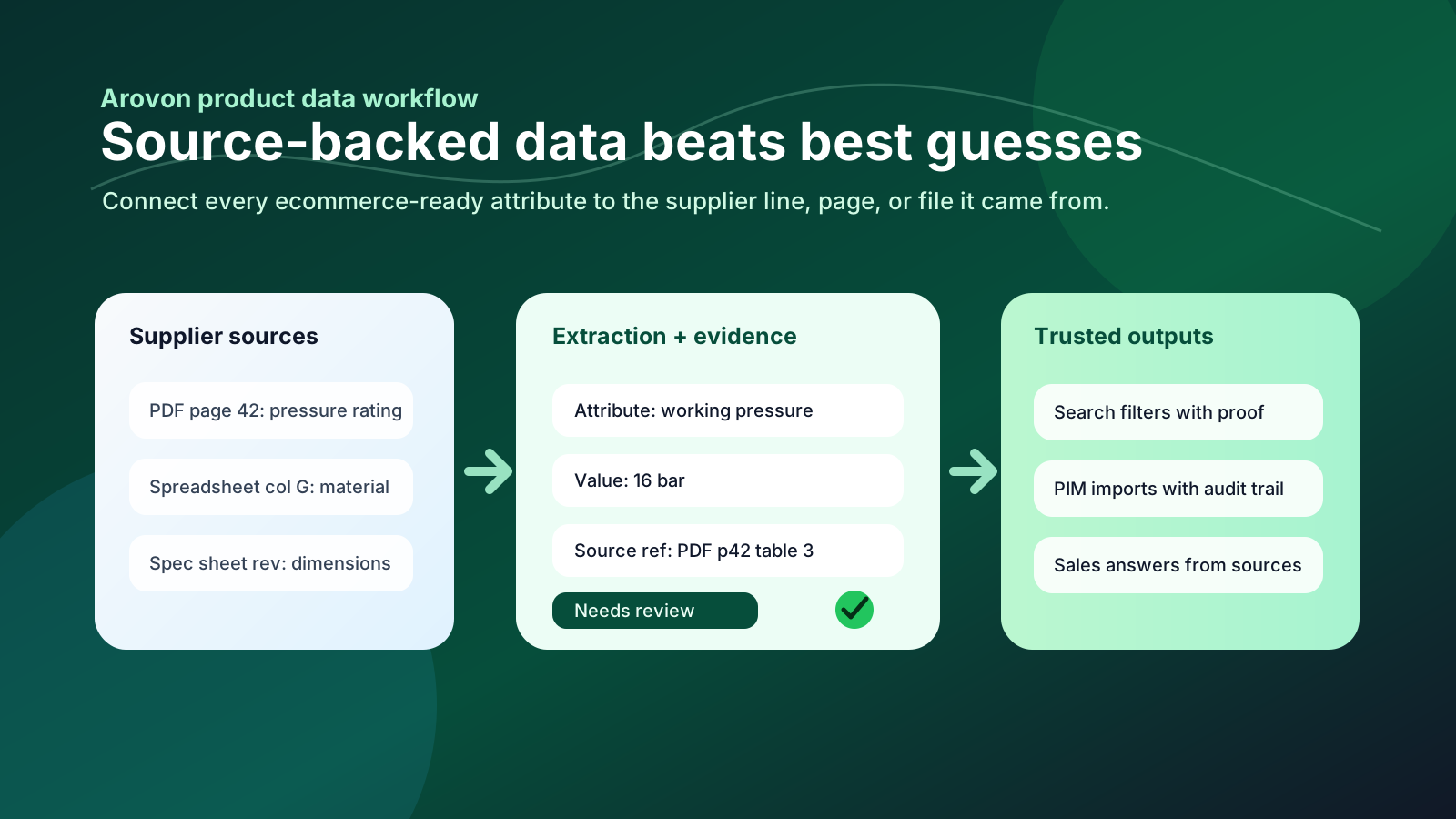
Industrial distributors do not lose buyer trust because a field is empty once. They lose trust when nobody can explain where a published specification came from, why a value changed, or whether a salesperson should rely on it during a quote. That is the real promise of source-backed product data: not just cleaner ecommerce content, but a repeatable way to connect every important product fact to the supplier document, spreadsheet, feed, or reviewed decision behind it.
This matters more as B2B buyers expect self-service research, fast quoting, and consistent information across web stores, sales conversations, and account portals. A distributor can add a PIM, rebuild a Shopify or BigCommerce catalog, or experiment with AI search, but weak source traceability still creates the same problem: teams hesitate because they cannot see the evidence behind the data.
Source-backed product data is a practical operating model. It says that a pressure rating, thread size, material, compatibility note, UNSPSC code, or replacement part relationship should carry enough context for a human reviewer to trust it before it reaches ecommerce, PIM, RFQ, or ERP-adjacent workflows.
Quick skim: what source-backed data changes
Evidence travels with the value
A normalized attribute keeps its supplier file, page, row, column, date, and original wording close enough for review.
Review becomes targeted
Teams focus on conflicts, missing units, and risky assumptions instead of rereading every supplier PDF manually.
Exports become safer
Ecommerce, PIM, RFQ, and sales tools receive reviewed facts rather than disconnected fields with unclear origin.
What source-backed product data means
Source-backed data means each important product fact is stored with a trail back to its origin. The source might be a supplier PDF, a spreadsheet tab, a price list, a technical datasheet, a manufacturer feed, an ERP field, or a reviewed exception decision made by your catalog team.
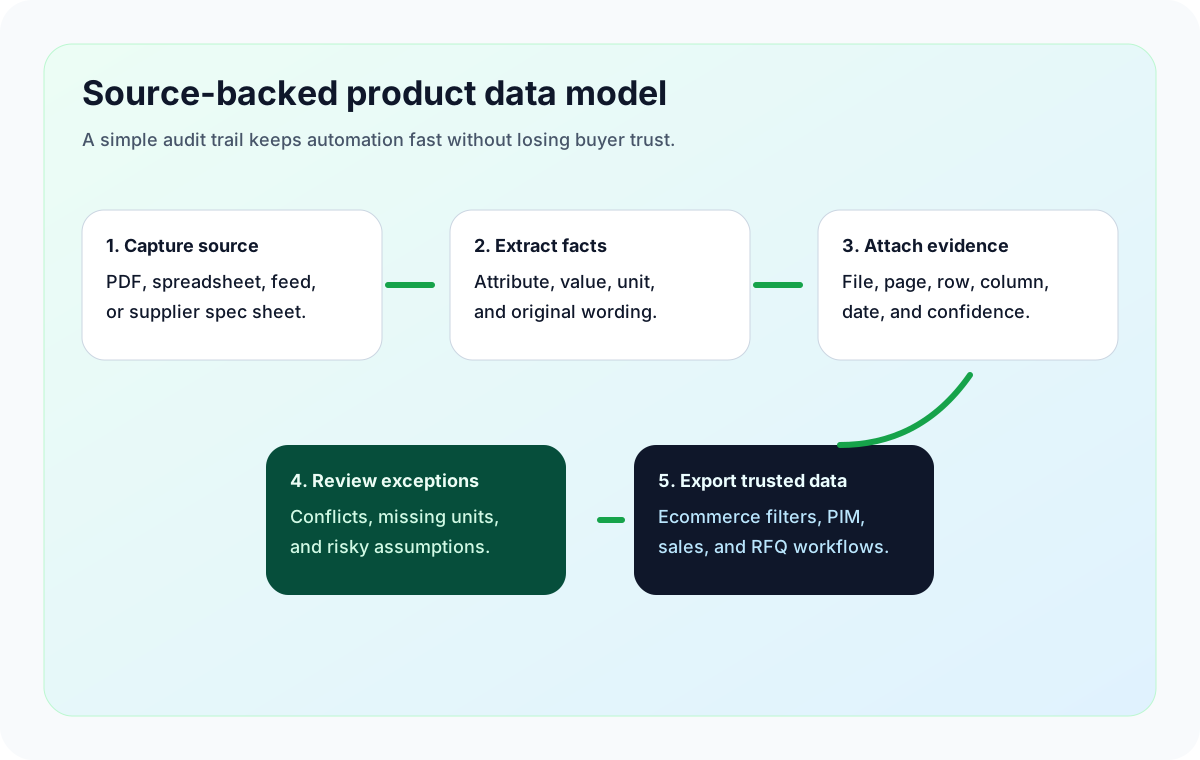
The model is simple: capture the raw fact, normalize it into the structure your buyers and systems need, attach the evidence, then route uncertain cases for review. A source-backed row might say: working pressure = 16 bar, original wording = “max pressure 16 bar,” source = supplier catalog 2026, page = 42, table = 3, status = reviewed, reviewer = catalog operations.
That extra context is what separates useful automation from risky data generation. The goal is not to slow down the team with documentation for its own sake. The goal is to make product data fast enough to scale and trustworthy enough to publish.
Why distributors need more than “cleaned” fields
A clean field can still be dangerous if nobody knows how it was produced. For example, a supplier spreadsheet might show “SS” in a material column. In one family it means stainless steel; in another it could be a suffix inside a part number. A model can suggest the likely meaning, but a distributor needs the original context available when the case is reviewed.
The same issue appears with units, dimensions, replacement parts, pressure ratings, pack quantities, and compliance notes. A value may look tidy in a spreadsheet while hiding a decision that should not be automated blindly.
The test is not “does the field look clean?” The test is “could a catalog manager explain the evidence behind it in thirty seconds?”
When the source trail is missing, teams fall back to tribal knowledge. Sales asks operations. Operations asks a product specialist. Someone opens three PDFs and an old spreadsheet. The buyer waits. The web store may still show a value, but internal confidence is low.
The source-backed workflow
A practical workflow does not require every distributor to redesign its entire data architecture at once. Start with the product families where bad data causes visible ecommerce, quote, or support friction.
Capture source files before extraction. Store the supplier name, document title, version or received date, page, row, sheet, and file location where possible.
Extract the raw wording and the candidate structured value. Keep both. The raw wording helps reviewers understand how the normalized value was produced.
Normalize units, attribute names, identifiers, and allowed values against your ecommerce or PIM model, not against a one-off supplier spreadsheet.
Flag conflicts and uncertainty. Missing units, duplicate identifiers, contradictory dimensions, and low-confidence mappings should become review tasks.
Record the review decision. Once a human confirms, corrects, or rejects a value, that decision should be reusable the next time similar supplier data arrives.
Export only reviewed or policy-approved fields into ecommerce product data workflows, PIM, quote tools, or channel imports.
Where the source trail should appear
The source trail does not need to be visible to every buyer. In most cases it belongs inside the catalog operations workflow, review interface, staging table, or product data automation layer. Buyers need clear specifications and helpful pages; your internal team needs the proof behind those specifications.
For ecommerce, source-backed data supports better filters, cleaner product titles, reliable variant grouping, and stronger product descriptions. For sales and RFQ teams, it provides confidence when a buyer asks whether a product meets a requirement. For management, it makes product-data automation easier to measure because reviewed data can be separated from unreviewed guesses.
The key is to avoid throwing away the evidence during cleanup. Too many workflows convert supplier files into a flat CSV, import the CSV, and lose the context needed for later maintenance.
Source-backed vs. guess-backed product data
Guess-backed cleanup
Looks fast in the first spreadsheet.
Overwrites raw supplier wording.
Leaves unclear assumptions inside polished fields.
Creates rework when sales or buyers challenge a value.
Makes AI search and filters depend on unverified data.
Source-backed cleanup
Keeps the original value and normalized value together.
Shows where each important fact came from.
Routes uncertain cases to review instead of publishing them.
Builds reusable decisions for future supplier updates.
Gives ecommerce, PIM, and RFQ workflows cleaner inputs.
A pilot scorecard for source-backed data
If you are starting from messy supplier documents, do not try to source-back the whole catalog in one project. Choose a product family where the business case is visible and the source materials are representative.
Business impact: products influence revenue, quote volume, search exits, support tickets, or relaunch scope.
Source availability: supplier PDFs, spreadsheets, feeds, and spec sheets are accessible and can be linked to extracted rows.
Attribute reuse: the model will help many SKUs, not just one unusual item.
Review feasibility: a catalog, product, or sales expert can validate exceptions without becoming the bottleneck for every field.
Export path: there is a clear target such as Shopify metafields, BigCommerce catalog fields, Adobe Commerce attributes, a PIM import, or a staging table.
A good pilot should prove two things: automation can extract and normalize useful data faster than manual work, and the source trail makes the result easier for humans to trust.
Where Arovon fits
Arovon is built around the messy upstream work that comes before a reliable ecommerce catalog: supplier documents, spreadsheets, extracted product rows, normalized attributes, human review, and exports into the systems your team already uses.
For distributors preparing a catalog cleanup, web-store relaunch, AI search project, or PIM import, a source-backed workflow helps the team move faster without pretending that technical product data can be fully automated without review.
If you want to see how this could work with your supplier files, request a demo or review the pricing options. A short pilot can identify which product family, source types, and review rules should come first.