The Hidden Cost of Bad Product Data in B2B Ecommerce
6/15/2026
Bad product data does not only make a catalog look messy. For B2B distributors, it quietly raises support costs, slows quoting, weakens search, and makes buyers less confident in self-service ordering.
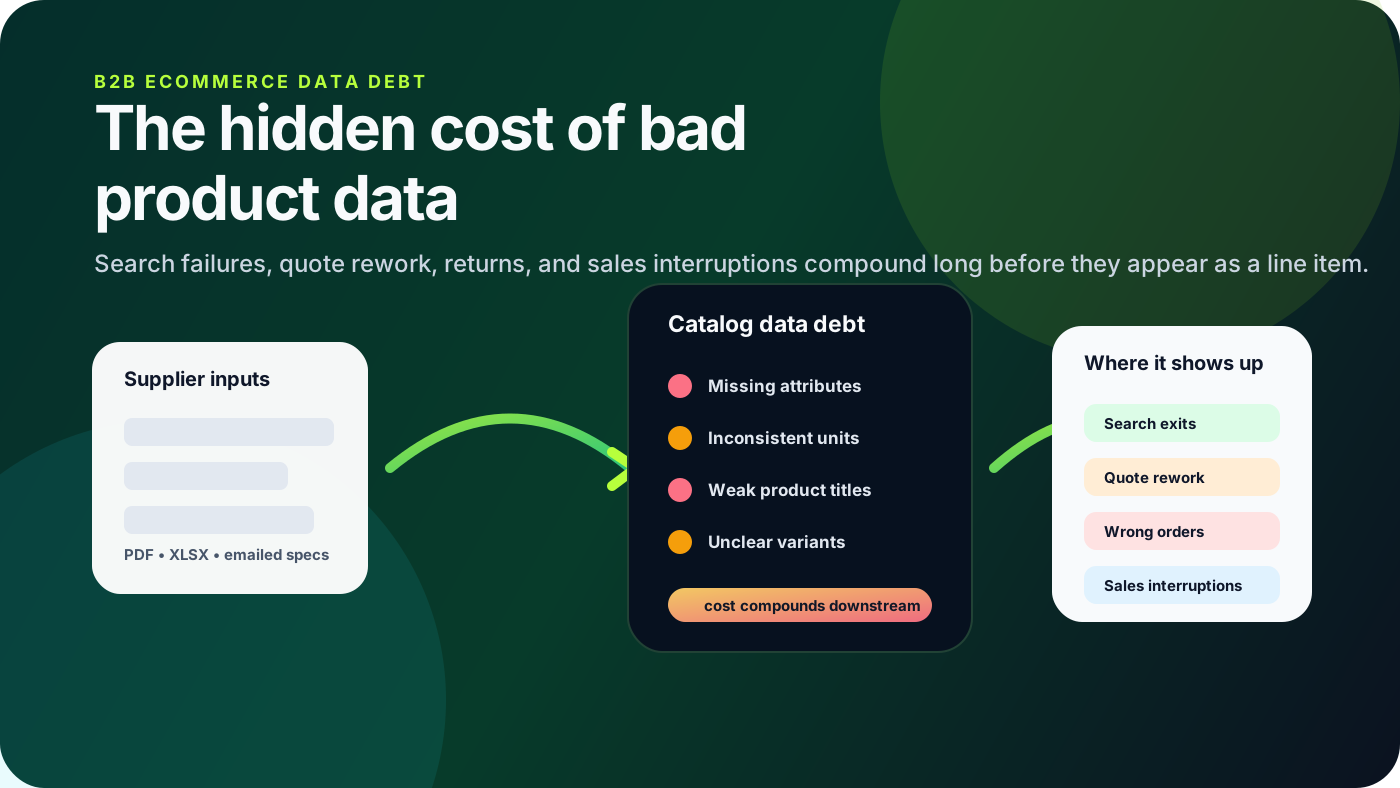
Bad product data is easy to underestimate because it rarely appears as one clean invoice. It shows up as abandoned searches, extra sales calls, manual quote checks, delayed ecommerce launches, avoidable returns, and product managers spending another afternoon reconciling supplier spreadsheets. Each symptom looks operational. Together, they become a margin problem.
For industrial distributors, the risk is getting larger as B2B buyers expect more self-service. Gartner reported in 2025 that a majority of B2B buyers prefer a rep-free buying experience, while McKinsey’s 2026 B2B Pulse describes ecommerce and omnichannel capability as a minimum requirement rather than a differentiator. Those expectations only work when the catalog is trustworthy enough for buyers to search, compare, configure, and order without calling your team for every detail.
This guide explains where the hidden costs come from, how to spot them, and how to start reducing them with a focused product data workflow. If you are already preparing a catalog cleanup, the practical next step is to compare your current process with Arovon’s supplier-document-to-product-data workflow or request a short demo.
Quick skim: where bad data creates cost
Buyer-facing cost
Weak titles, missing attributes, inconsistent units, and unclear variants make search and filters unreliable. Buyers either call sales, send an RFQ, or leave.
Internal cost
Catalog, sales, and operations teams repeatedly check PDFs, ERP records, old spreadsheets, and supplier emails to answer questions that the storefront should resolve.
Growth cost
New suppliers, categories, and ecommerce launches move slowly because every import creates exception handling, rework, and confidence checks.
The cost is hidden because it is spread across teams
A messy catalog does not usually trigger one obvious budget line called “bad product data.” Instead, the cost lands in different departments. Ecommerce sees low conversion on technical categories. Sales sees more calls for basic specification checks. Customer service handles “is this the same part?” questions. Operations deals with returns, replacements, and order corrections. Product managers slow down new category launches because they do not trust the import file.
That distribution makes the problem politically difficult. Each team may optimize its own workaround: a spreadsheet, a sales note, a manual QA step, or a small script. But the buyer still experiences one catalog. If the product page cannot answer a practical purchasing question, the cost is simply pushed somewhere else.
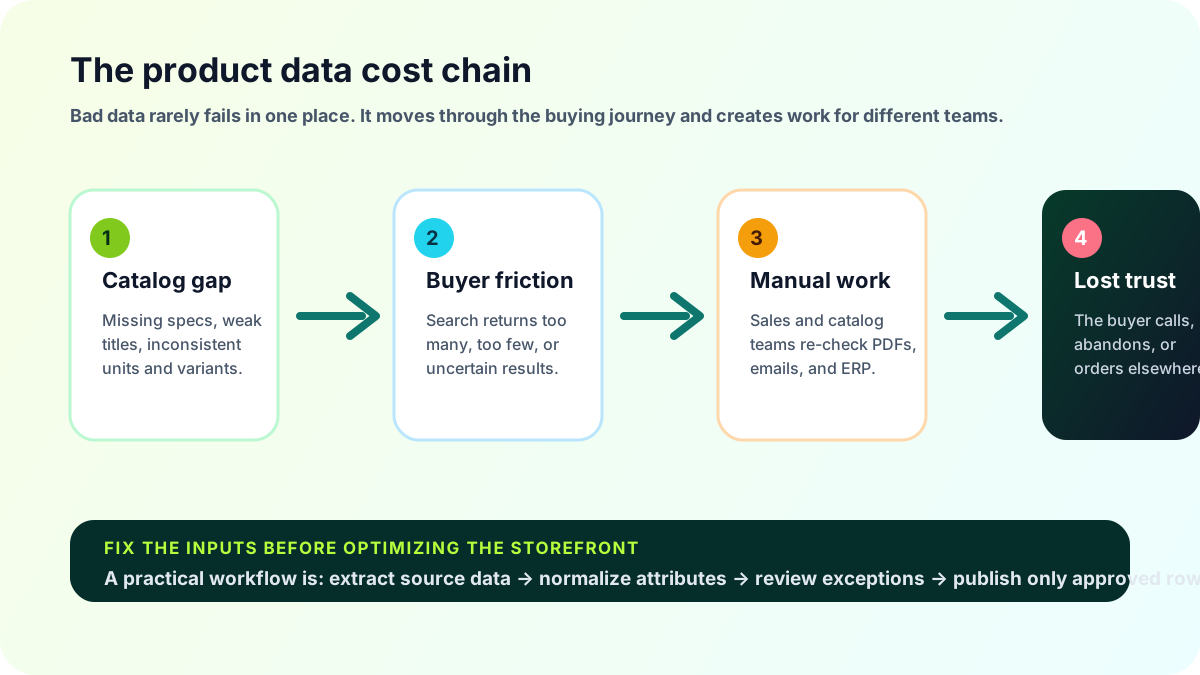
Bad data is not just a content issue. It is a workflow issue that transfers work from the catalog system to buyers, salespeople, and operations teams.
Search failure is often the first visible symptom
In B2B ecommerce, search is unforgiving. A buyer may know a manufacturer part number, a partial description, a size range, a material, a load rating, or a compatibility constraint. If those details are trapped in a PDF, stored in inconsistent fields, or written differently across suppliers, the search experience becomes unpredictable.
The direct cost is fewer self-service orders. The indirect cost is lower trust. Buyers learn that the website is not a reliable place to answer technical questions, so they revert to phone calls, email, and quote requests even for products that should be straightforward to reorder.
Missing attributes prevent useful filters such as diameter, thread type, voltage, load capacity, material, pressure range, or package quantity.
Inconsistent units split equivalent products across separate filter values, for example mm versus millimeter or lb versus pounds.
Unstructured titles force buyers to read every row because the most important differentiator is not predictable.
Weak synonym and part-number handling makes exact-match buyers feel as if the product is not available.
Quote and sales work becomes more expensive than it looks
Many distributors accept quote work as part of the business model. That is reasonable for custom assemblies, negotiated contracts, configured products, and account-specific pricing. It is expensive when quoting is used to compensate for basic catalog uncertainty.
A common pattern looks like this: the buyer finds a possible item, cannot confirm the specification, sends an email, and the sales team checks the supplier PDF or ERP notes. If the answer requires a product specialist, the request moves again. The final response may be accurate, but the company has used expert time to fill a gap that structured product data could have prevented.
Bad data pattern | Hidden cost | Better data practice |
|---|---|---|
“See catalog” instead of attributes | Sales checks PDF pages for routine specs | Extract key attributes into searchable fields |
Different names for the same unit | Filters split and imports need manual cleanup | Normalize units before publishing |
Variant details buried in descriptions | Buyers cannot compare rows confidently | Model variants with consistent option fields |
No source trace for changed values | Teams hesitate to approve updates | Keep source-backed review notes and approvals |
Bad data slows every new supplier and category launch
The cost is not limited to today’s catalog. Poor product data also reduces speed. When a supplier sends a new PDF, spreadsheet, or price file, the team has to decide which fields matter, how they map to ecommerce, which values are safe to publish, and which exceptions require review. If there is no repeatable process, every launch becomes a custom project.
This matters because B2B ecommerce growth often depends on breadth: more SKUs online, more long-tail products discoverable, more supplier lines available for reorder, and more categories with usable filters. When each new file requires heavy manual cleanup, the catalog roadmap becomes constrained by data preparation capacity rather than buyer demand.
A practical scorecard for finding the real cost
You do not need a perfect cost model to start. A simple scorecard can reveal where bad product data is already creating measurable drag. Review one important category and ask how many of the following are true.
Buyer experience
Top search terms return irrelevant results.
Important filters are missing or sparse.
Product titles do not expose the main differentiator.
Buyers often ask whether two rows are equivalent.
Internal workflow
Sales checks supplier PDFs for routine questions.
Catalog imports need repeated spreadsheet cleanup.
ERP fields cannot support ecommerce filters alone.
No one can quickly show the source for a changed attribute.
If several boxes are true, the hidden cost is already present. The right question is not “Can we afford product data cleanup?” It is “Which manual costs and missed self-service orders are we already accepting?”
How to reduce the cost without boiling the ocean
The most effective fix is usually not a giant, all-at-once data transformation. Start with a category where better data would clearly improve buyer decisions: a high-volume fastener line, a technical component family, a supplier with frequent RFQs, or a category that matters to an upcoming website relaunch.
Define the buyer decision fields: the attributes a customer actually uses to compare, filter, and confirm fit.
Extract from source documents into a staging table instead of editing directly in the ecommerce platform.
Normalize units, names, and allowed values before import so filters do not fragment.
Create an exception review step for low-confidence or business-critical fields.
Publish approved rows, then measure search exits, support questions, quote volume, and import rework for that category.
This is where Arovon fits. The platform is designed to turn supplier PDFs and spreadsheets into structured product data, route exceptions for review, and prepare approved exports for ecommerce workflows such as Shopify product imports, catalog cleanup, and PIM-ready enrichment. The goal is not to remove human judgment. It is to reserve human judgment for the rows and fields that actually need it.
What to do next
Pick one product family and trace the current journey from supplier file to live product page. Count how many times a person has to retype, rename, verify, or re-check the same information. Then identify which attributes would make the biggest difference to buyer confidence and self-service ordering.
If you want help turning that into a repeatable workflow, request a demo or review Arovon’s pricing to see how product data automation can fit into a focused catalog improvement project.