What Makes Industrial Product Data Different From Consumer Product Data?
8/6/2026
Consumer product data is built to sell a finished item quickly. Industrial product data has to prove fit, compatibility, evidence, and readiness for ERP, PIM, and ecommerce workflows.
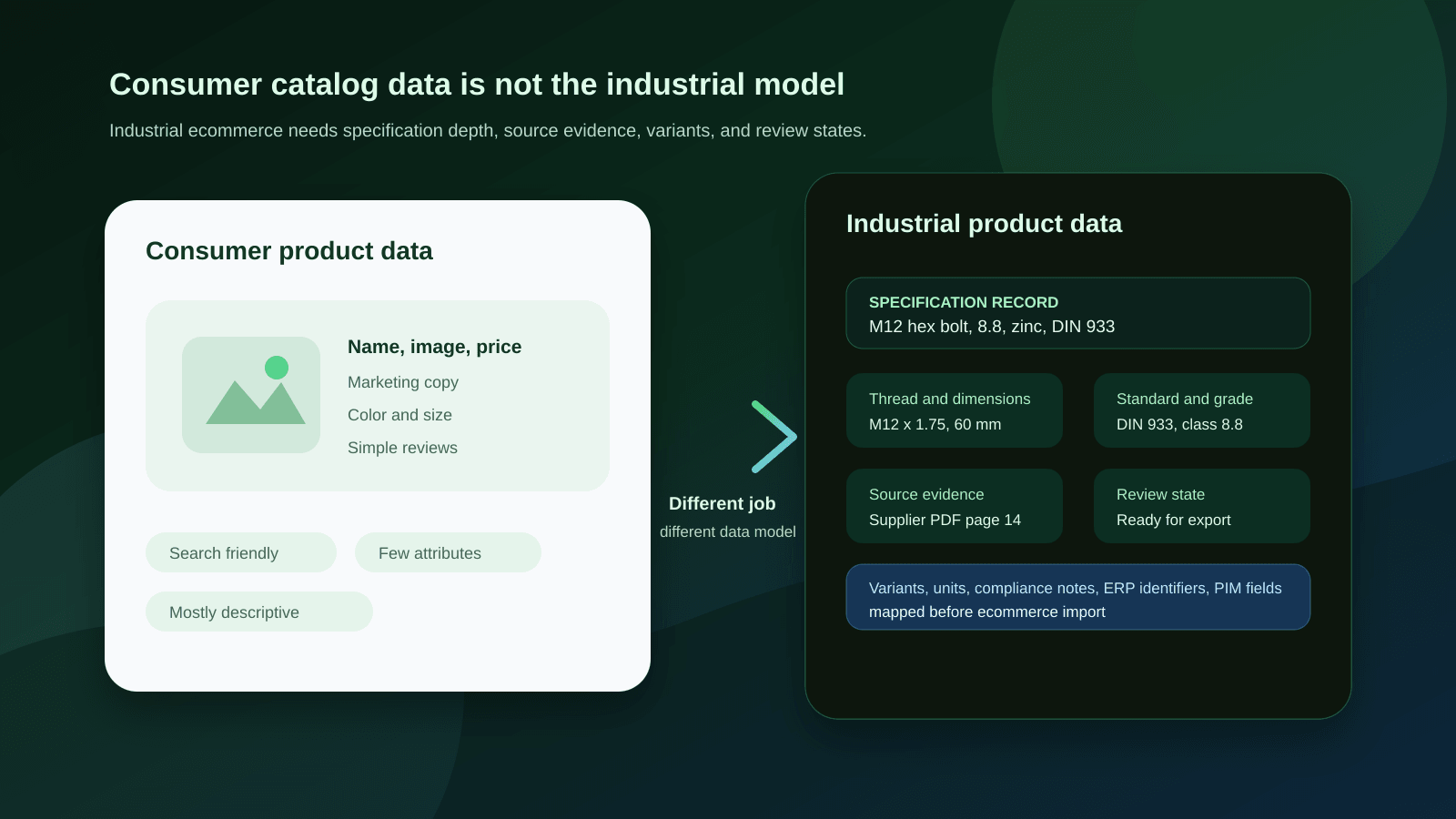
Consumer ecommerce taught buyers to expect clean search, clear images, reviews, and a frictionless checkout. That standard now influences B2B buying too. But industrial distributors cannot simply copy consumer product data practices and expect the catalog to work.
A consumer product record usually answers a relatively simple question: is this the color, size, style, and price I want? An industrial product record has to answer a riskier question: will this item fit the application, meet the required standard, work with the surrounding equipment, and remain traceable back to a reliable source?
That difference matters when a distributor is preparing data for product data automation, ecommerce search, a PIM, an ERP import, or a web-store relaunch. The goal is not just richer copy. The goal is a product data model that buyers, sales teams, and operations can trust.
Quick skim: where industrial data changes the work
Consumer data
Optimizes for merchandising, conversion, and simple choice. The item is usually self-contained and buyer risk is lower.
Name, image, price, ratings
Color, size, style, brand
Lifestyle copy and availability
Industrial data
Optimizes for fit, specification confidence, compatibility, and downstream operational rules.
Technical attributes and standards
Units, variants, source evidence
ERP, PIM, ecommerce, and quote readiness
Consumer product data describes the item. Industrial data describes the decision.
For many consumer products, the page exists to make a product attractive and easy to buy. The data model can stay relatively shallow because the buyer can evaluate the product through photos, reviews, dimensions, and a few options.
Industrial buyers are often solving a constraint. A maintenance team needs a seal that tolerates a specific medium and temperature. A purchasing team needs a replacement bearing that matches dimensions, load rating, and suffix logic. A fabricator needs fasteners with the correct standard, material, coating, grade, and pack unit. If one of those fields is wrong or missing, the ecommerce page may still look polished while the buying decision fails.
That is why industrial catalog cleanup should start with the buyer decision, not the page template. Ask what the buyer must confirm before they can add the item to a cart, request a quote, or send it to an engineer for approval.
The source landscape is messier
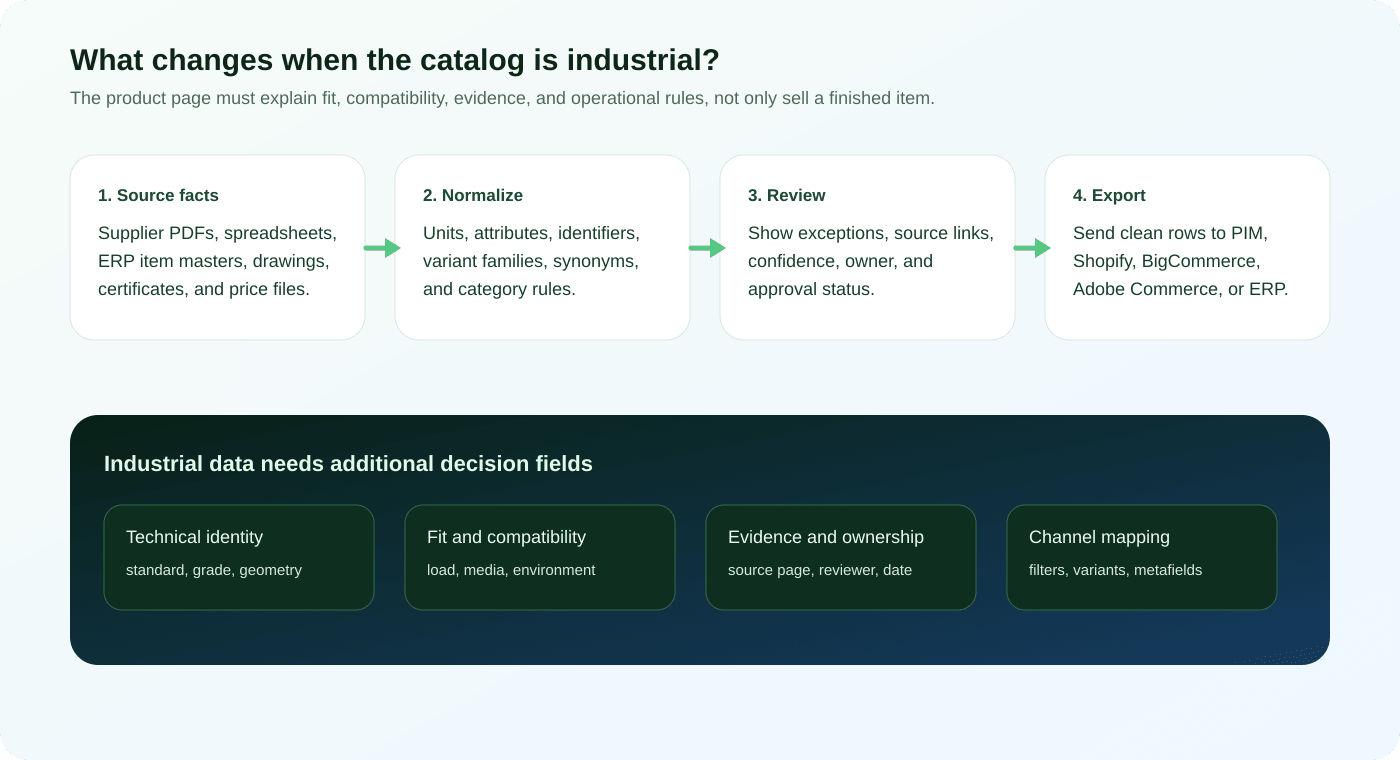
Consumer product teams may still wrestle with feeds and vendor files, but industrial distributors commonly inherit decades of source formats: supplier PDFs, scanned catalogs, ERP item masters, spreadsheets, price lists, dimensional tables, certificates, and sales notes. The same product family may appear in several supplier formats, and the useful facts may be split across footnotes, table headers, product codes, and separate data sheets.
This source complexity changes the cleanup workflow. It is not enough to paste a supplier description into a product page. A distributor needs to extract facts, normalize names and units, keep the original value where useful, and retain enough evidence for a reviewer to understand why the new value is trustworthy.
For industrial catalogs, source evidence is not an administrative extra. It is what lets sales, ecommerce, and operations trust the data after automation has touched it.
Attributes have operational consequences
In consumer ecommerce, an attribute such as color or size usually helps filtering, merchandising, or variant selection. In industrial ecommerce, an attribute can affect product fit, quote routing, substitute selection, compliance language, and customer support workload.
A thread size, pressure rating, bore diameter, hardness, tolerance, or IP rating is not just content. It may decide whether a buyer finds the product, whether a sales rep can recommend an alternative, whether a PIM export passes validation, and whether an ERP-connected order can be fulfilled without follow-up.
This is also why industrial attributes need stricter governance. Teams should define canonical names, canonical units, allowed values, source references, confidence levels, and owner/reviewer rules for the fields that matter most.
Industrial variants are not just merchandising options
Consumer variants are often easy to understand: one shirt in several sizes and colors, one device in several storage capacities. Industrial variants can be much harder because part numbers encode technical meaning, supplier families are inconsistent, and small changes can create a different application fit.
A bearing series may vary by seals, shields, clearance, cage type, bore, outside diameter, width, and suffix. A bolt family may vary by thread, length, grade, coating, head style, and standard. Group variants too loosely and buyers see misleading choices. Split them too aggressively and search results become cluttered.
The practical move is to define the variant axis by product family and buyer behavior. Which differences should be selectable on one product page? Which differences should become filters? Which differences should stay as specifications or compliance notes? The answer changes by category.
A useful scorecard before importing industrial product data
Can a buyer search by the terms they actually use, including supplier part numbers, manufacturer codes, synonyms, and common abbreviations?
Are the critical technical attributes present, normalized, and stored in fields rather than buried in paragraphs?
Do units have a canonical value, display value, and original source value where conversion risk exists?
Can sales or category managers see the source document, page, row, or note behind important fields?
Are variants grouped around real buyer decisions instead of supplier spreadsheet convenience?
Is the export mapping clear for the target channel: Shopify metafields, BigCommerce custom fields, Adobe Commerce attributes, PIM fields, or ERP staging tables?
Where B2B ecommerce trends make this more urgent
Current B2B ecommerce guidance from BigCommerce, Sana Commerce, Shopify, and Salesforce points in the same direction: business buyers expect more self-service, more accurate storefront facts, personalized catalogs, account-specific buying rules, and less manual friction. That does not reduce the need for sales expertise. It raises the standard for the product data that supports sales and self-service together.
A polished site with weak industrial data creates a familiar failure pattern. Buyers search and filter, but cannot confirm fit. They submit quote requests for basic questions. Sales teams re-check supplier documents. Ecommerce teams hesitate to publish more products because every import creates cleanup work. The bottleneck is not always the platform. Often, it is the missing product data layer between supplier sources and the storefront.
A practical way to model industrial product data
Distributors do not need to perfect every field before improving the catalog. Start with a small product family where missing data creates visible buyer or sales friction. Build a field model around the decision: identifiers, must-have specifications, units, variant rules, source evidence, review status, and export mapping.
Then run a pilot workflow. Extract supplier facts from PDFs and spreadsheets. Normalize the fields that matter. Route exceptions to a knowledgeable reviewer. Export only approved rows to ecommerce or a staging table. Measure search quality, quote reduction, import errors, and reviewer time. The result is a repeatable system, not a one-time cleanup project.
Where Arovon fits
Arovon is built for the gap between messy supplier documents and trustworthy product data. The workflow helps teams move from PDFs, spreadsheets, and inconsistent source files into reviewed product rows that can support ecommerce, PIM, ERP staging, and sales workflows. If your team is preparing an industrial catalog for self-service buying, start with a focused product family and request a demo to see how the source-to-review-to-export process can work in practice.
You can also review pricing or contact Arovon if you want to discuss a specific catalog cleanup or ecommerce import project.