How Industrial Distributors Can Reduce Manual Quote Work With Better Product Data
6/24/2026
Manual quote work is not only a sales-process problem. For industrial distributors, it often starts with incomplete product data, supplier PDFs, inconsistent identifiers, and specs that are hard to reuse.
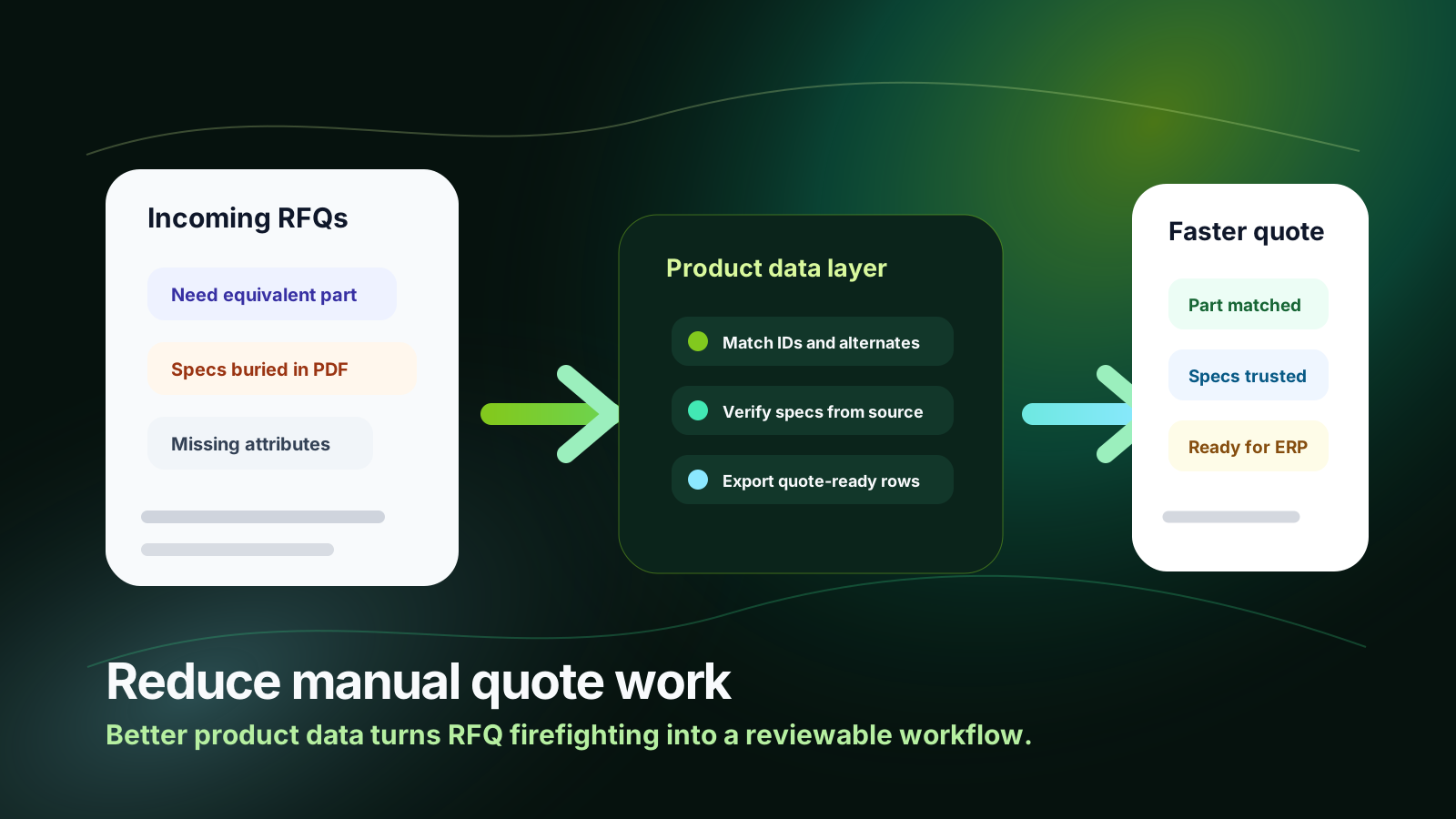
Manual quote work is easy to blame on the quoting tool. But in many industrial distribution teams, the real problem appears earlier: sales is asked to quote products that are not cleanly represented in the catalog. A buyer sends a manufacturer part number, an old drawing, a PDF page, or a description from a previous order. The team then has to identify the product, confirm specifications, check substitutes, and re-key the answer into an ERP, spreadsheet, or quote system.
That work may be necessary for complex orders, but too much of it is avoidable. Better product data will not remove every judgment call from quoting. It can, however, remove repeated lookup, copying, interpretation, and rechecking. The goal is not a fully automated “black box” quote. The goal is a source-backed product data layer that gives sales a reliable starting point.
Quick skim
Quote delays often start with missing product identifiers, weak attributes, and supplier data trapped in PDFs or spreadsheets.
A useful RFQ workflow separates product-data cleanup from price, margin, stock, and customer-specific negotiation.
Start with the quote categories that repeat often and require the same specification checks every time.
What changes
Sales spends less time hunting for specs and more time resolving commercial questions.
Catalog, ecommerce, and quoting teams reuse the same reviewed attributes instead of maintaining separate truths.
Exceptions become visible: missing unit, conflicting material, unclear equivalent, or unsupported product family.
Where manual quote work really comes from
A typical distributor quote request combines commercial questions with product-data questions. Commercial questions include price, availability, delivery date, freight, customer agreement, margin, and substitution policy. Product-data questions include: What exactly is this part? Which supplier identifier is authoritative? What dimensions, materials, standards, ratings, and units matter? Is there an equivalent part? Does the ecommerce product page describe it correctly?
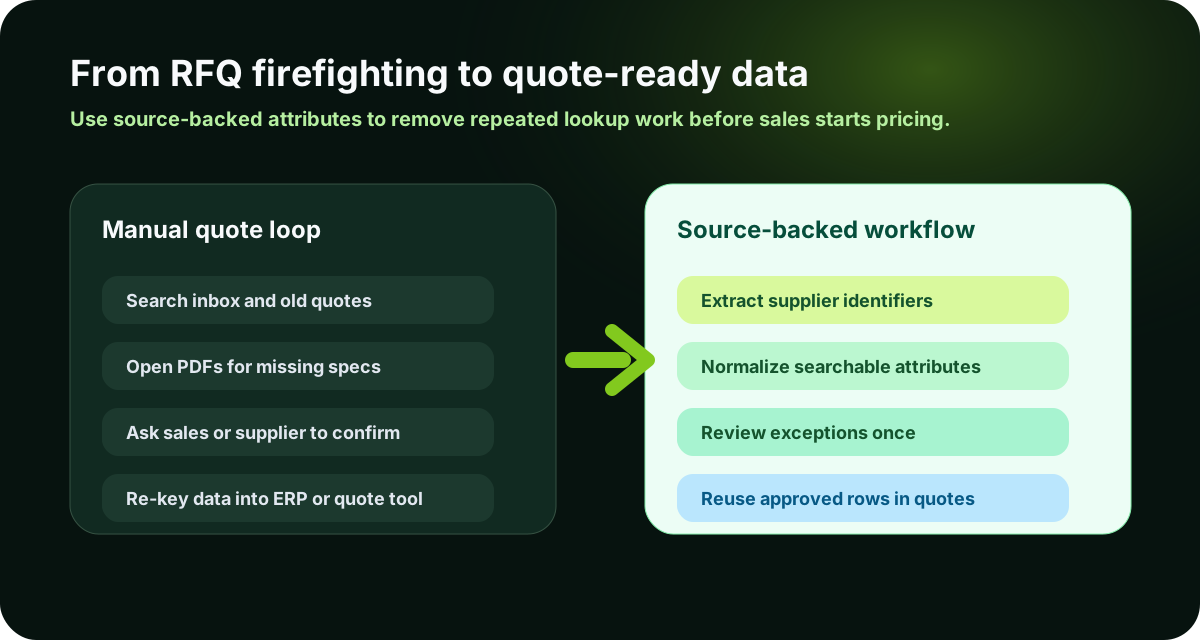
When product-data questions are unresolved, every quote becomes a mini catalog project. Sales opens supplier PDFs, searches old emails, checks ERP descriptions, asks a product specialist, and copies answers into the quote. If the same family is quoted again next week, much of that work repeats because the result was never captured as structured, reusable data.
The product data that makes quotes faster
A quote-ready product record does not need to contain every possible piece of information. It needs the fields that help the team identify, qualify, and communicate the item confidently. For industrial distributors, that often means:
Authoritative identifiers: supplier part number, manufacturer part number, internal SKU, GTIN where relevant, and common aliases.
Core technical attributes: dimensions, material, finish, grade, rating, standard, tolerance, size, pressure, temperature, thread, load, or other category-specific fields.
Normalized units: one chosen representation for buyer-facing search and comparison, with source values preserved for traceability.
Compatibility and substitution notes: equivalent families, “do not substitute” flags, and where human approval is required.
Source references: the PDF, spreadsheet, catalog page, supplier feed, or ERP record used to justify the value.
This is where a product data automation workflow can help. Supplier documents can be extracted into rows, normalized into consistent attributes, reviewed by a human, and exported into the systems that need them. Arovon is built around that practical sequence: supplier documents in, structured product rows out, with review before publishing or importing.
Separate product-data cleanup from price calculation
One common mistake is trying to solve quoting by jumping directly to automatic price generation. That is risky when the underlying product identity is still uncertain. A safer path is to make the product-data layer reliable first, then let ERP, pricing rules, sales judgment, and customer agreements do their work.
Faster quoting usually starts by making repeated product questions reusable, not by removing every human decision from the quote.
For example, if a buyer asks for a stainless fastener by a supplier code, sales should not have to rediscover diameter, length, thread, material, finish, packaging, and equivalent internal SKU from scratch. Those fields should already be available in a reviewed row. The quote still needs pricing and availability, but the product-identification work has largely been completed once.
A practical workflow for reducing RFQ effort
A distributor does not need to clean the entire catalog before seeing benefits. A focused pilot can prove where product data removes manual work. Start with a recurring quote category, such as a fastener family, a seal family, a spring range, a consumables group, or a set of supplier catalogs that regularly create back-and-forth.
Collect the source files that sales already uses: PDFs, price sheets, old quote exports, ERP item lists, and supplier spreadsheets.
Define the minimum fields required to answer common RFQs for that product family.
Extract supplier identifiers and technical specs into a staging table rather than editing directly in the ecommerce platform or ERP.
Normalize units, naming, and attribute labels so records can be searched and compared.
Review exceptions with product specialists: conflicting values, missing dimensions, unclear substitutes, or attributes that should not be published.
Export approved rows to the systems that need them: ecommerce, PIM, ERP item enrichment, quote templates, or sales enablement sheets.
Before and after: what the team experiences
Before
Sales searches PDFs and old quotes for the same attributes repeatedly.
Catalog managers receive urgent one-off cleanup requests from active deals.
Ecommerce content, ERP descriptions, and quote text drift apart over time.
Product specialists become bottlenecks for routine specification questions.
After
Common attributes are reviewed once and reused across quote, catalog, and ecommerce workflows.
Sales can identify products faster and escalate only genuine exceptions.
Catalog and ecommerce teams work from a source-backed staging layer.
Managers can see which product families create the most avoidable RFQ friction.
What to measure in the first pilot
The strongest business case is not “AI saves time” in the abstract. It is a visible reduction in specific manual steps. Track a small set of operational measures before and after the pilot:
Average time spent identifying the product before price and availability checks begin.
Number of RFQs requiring a product specialist for routine attribute confirmation.
Percentage of quote requests with a matched internal SKU or reviewed supplier identifier.
Number of repeated lookups eliminated because attributes were captured in the staging layer.
Exception rate by supplier or product family, such as missing units, conflicting material, or incomplete dimensions.
These measures help leadership see that product data is not only a website problem. It affects sales response time, customer confidence, and the ability to scale without adding more manual coordination.
Where Arovon fits
Arovon helps distributors turn supplier PDFs and spreadsheets into structured product data that can be reviewed and exported. That makes it useful before a supplier-document cleanup project, before a large ecommerce import, or before a focused quote-process improvement project. If your team is still copying specs from documents into spreadsheets and quotes, the next step is to identify one high-friction product family and build a repeatable data workflow around it.
If you want to see how this could work for your catalog, request a demo, review pricing, or contact Arovon with a sample supplier document and the quote workflow you want to improve.