The Distributor’s Guide to Ecommerce-Ready Product Descriptions
7/3/2026
Industrial product descriptions should help buyers confirm fit, compare options, and trust the source—not just fill a field in Shopify, BigCommerce, Adobe Commerce, or a PIM.
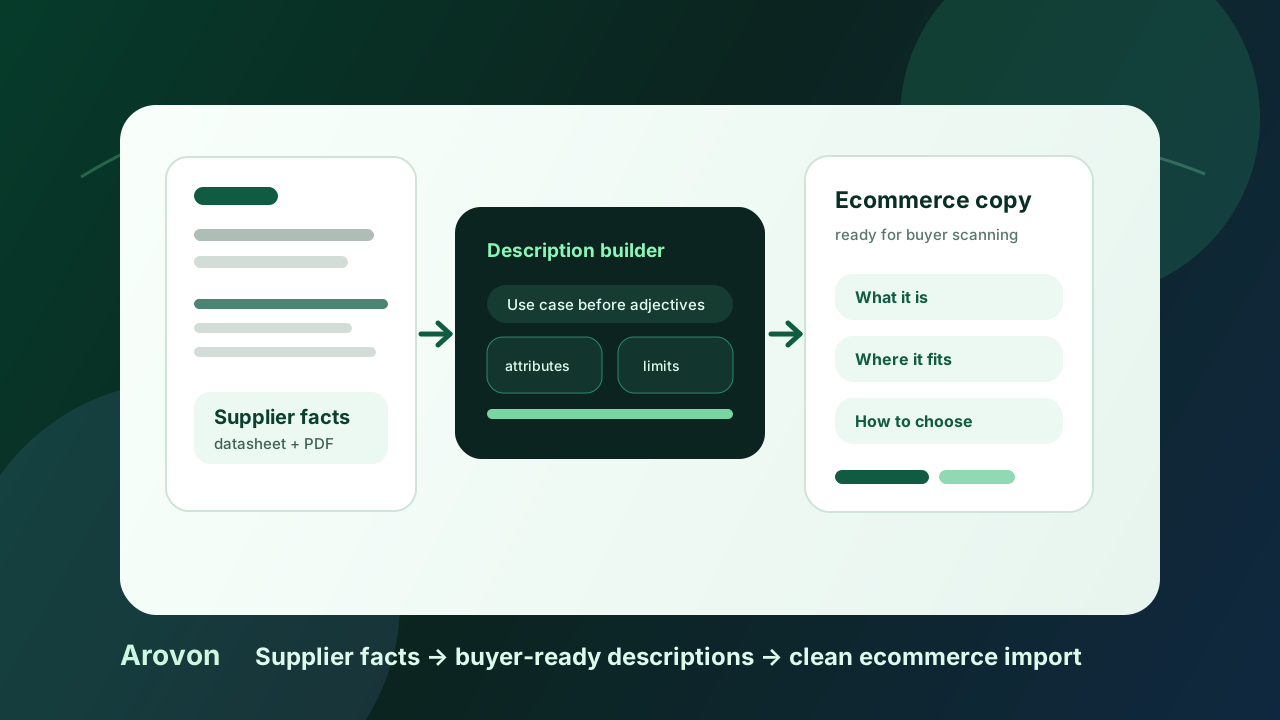
A product description for an industrial distributor has a harder job than consumer ecommerce copy. It has to explain the item clearly, preserve technical meaning, support search, and avoid claims that sales or engineering would not approve. If the description is vague, buyers call. If it is over-written, buyers distrust it. If it is copied directly from a supplier PDF, it may not fit the way your web store, PIM, or marketplace expects product content to work.
The goal is not to make every product page sound clever. The goal is to turn source-backed product facts into buyer-ready language that helps someone confirm fit and move forward. This guide gives distributors a practical model for writing ecommerce-ready descriptions from supplier catalogs, datasheets, spreadsheets, and ERP product records. It also shows where a workflow like Arovon can help extract, normalize, review, and export cleaner product content.
Quick skim: what a good industrial description must do
Identify the product in plain language before adding marketing language.
Translate supplier facts into buyer context without inventing unsupported performance claims.
Separate searchable attributes, selection details, and descriptive copy so each field does its job.
Preserve source traceability for dimensions, materials, standards, approvals, and limits.
Fit the destination channel: Shopify metafields, BigCommerce custom fields, Adobe Commerce attributes, PIM fields, or marketplace templates.
Start with the buyer’s question, not the supplier’s paragraph
Supplier descriptions often begin with how the manufacturer wants to present the product. Ecommerce buyers usually start somewhere else: “Is this the right type?”, “Will it fit?”, “What is the material?”, “Does it meet the standard?”, “Can I compare it with the alternative?”, and “Is this data trustworthy enough to order without calling?”
A useful description answers those questions in the first few lines. For a fastener, that may mean type, drive, head style, material, finish, thread size, and intended use. For a bearing, it may mean bearing type, bore, outside diameter, width, seal/shield configuration, load context, and compatibility cues. For a seal or O-ring, it may mean material, cross-section, inside diameter, temperature range, and fluid compatibility—only when those facts are actually source-backed.
Industrial ecommerce copy should reduce buyer uncertainty. If a sentence does not help identification, selection, comparison, compliance, or trust, it probably belongs somewhere else—or nowhere.
Separate four jobs: title, short description, long description, and attributes
Many distributor catalogs fail because every product field is asked to do too much. The title becomes a keyword dump. The short description repeats the title. The long description hides the useful data. Attributes are incomplete or inconsistent, so filters and comparison tables cannot help the buyer. Ecommerce-ready descriptions work better when each content field has a clear job.
Product title — Identify the item quickly with the most important differentiators. — Stuffing every spec into the title until it becomes unreadable.
Short description — Summarize what the product is and where it is used. — Repeating manufacturer brochure language with no buyer context.
Long description — Explain selection details, limits, compatibility, and practical use. — Inventing benefits that are not supported by the source document.
Attributes/metafields — Power filters, search, comparison, imports, and AI retrieval. — Leaving dimensions and units trapped in prose.
This split matters whether the destination is Shopify metafields, BigCommerce custom fields, Adobe Commerce attributes, a PIM, or a staging table before import. Descriptive copy should make the page understandable. Structured attributes should make it searchable, filterable, and reusable.
Use source-backed language instead of generic product claims
A supplier may provide exact dimensions, materials, certifications, application notes, and warnings. Those facts are valuable. But many generated product descriptions bury them under generic language such as “high quality,” “durable,” “reliable,” or “perfect for industrial use.” That type of copy is weak for two reasons: it does not help the buyer select the item, and it can imply claims your team has not verified.
A better approach is to convert facts into constrained, useful language. “Zinc-plated steel hex head cap screw with 1/4-20 thread” is more useful than “premium screw for demanding applications.” “Designed for use with compatible 6205 bearing housings; verify load and speed requirements against the manufacturer data sheet” is more trustworthy than “ideal for all heavy-duty machinery.”
Description wording test
Can the buyer see the product family and key differentiators without opening a PDF?
Are dimensions and units consistent with the attributes used elsewhere on the site?
Are standards, materials, approvals, and ratings copied only when the source supports them?
Does the copy explain compatibility or application context without promising universal fit?
Could sales, purchasing, or engineering approve the wording without rewriting it from scratch?
Build descriptions from reusable blocks
For large catalogs, writing every product description from a blank page is unrealistic. But copying supplier paragraphs is not a scalable strategy either. Distributors need reusable blocks that can be assembled from normalized data and then reviewed by a person when the product family is technical, high value, or safety-sensitive.
A practical description template might include: product identity, key attributes, application context, selection note, source-backed limitations, and a final sentence that points buyers to drawings, datasheets, or support when needed. The wording can vary by product family, but the structure should be repeatable enough that content quality improves over time instead of depending on whoever imported the last spreadsheet.
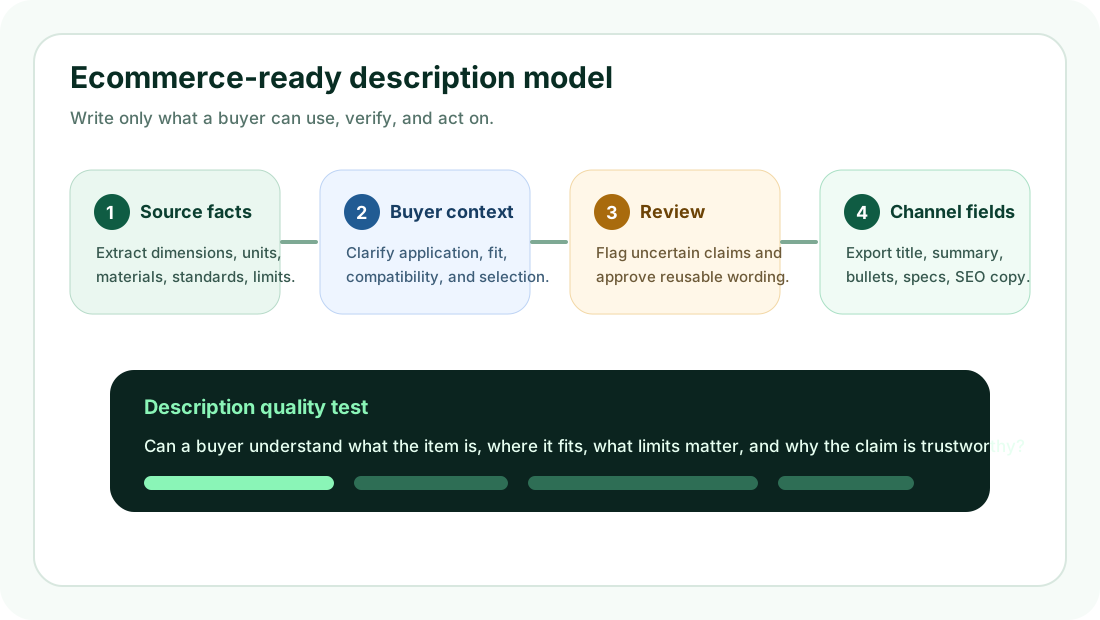
Extract the supplier facts from PDFs, catalogs, spreadsheets, and existing ERP records.
Normalize units, attribute names, product family names, and manufacturer terminology.
Generate or draft description blocks from approved rules for that product family.
Review exceptions: missing specs, conflicting units, unusual claims, or unclear compatibility.
Export the approved fields into ecommerce, PIM, marketplace, or quote-support systems.
Avoid the five description problems that create calls and returns
Poor descriptions usually create operational cost somewhere else. Buyers call customer service to confirm basic fit. Sales teams answer the same question repeatedly. Catalog managers patch pages one product at a time. Search results fill with near-duplicates because the same wording was pasted across multiple variants. Returns or order corrections increase when pages do not make constraints visible.
One-size-fits-all copy across multiple variants where size, material, or compatibility actually differs.
Unnormalized units such as inches, in., inch, mm, millimeter, and metric appearing inconsistently in copy and attributes.
Claims like heavy duty, food grade, corrosion resistant, or high temperature without a source-backed rating or standard.
Hidden selection logic that lives only in a PDF table, not in web-store attributes or buyer-facing guidance.
Descriptions that sound polished but do not include the facts needed for filtering, comparison, or confident ordering.
If these problems sound familiar, the issue is usually broader than writing. It is a product data workflow problem. Related cleanup work often includes unit normalization, better attribute strategy, source-backed review, and a controlled import process before content reaches ecommerce.
How Arovon fits into the description workflow
Arovon is not a replacement for product expertise or final review. It is a way to make the upstream work faster and more repeatable: pull facts from supplier PDFs and spreadsheets, normalize attributes, identify missing or conflicting data, support review, and prepare channel-ready exports. That foundation makes product descriptions easier to write because the raw material is cleaner.
For example, instead of asking a writer to read a PDF and manually decide which facts matter for every SKU, a distributor can extract the relevant rows, map attributes to a product family model, flag uncertain claims, and create approved description patterns. The result is not blind automation. It is a workflow where AI helps with extraction and structure while people keep control over technical accuracy and publishing decisions.
A practical pilot for better descriptions
Start with one product family that has commercial value, repeated buyer questions, and enough source consistency to learn from. Avoid the messiest category first unless it is also strategically important. The first pilot should prove the workflow: source files in, normalized product facts, reviewed description blocks, exported fields, and measurable improvement in page quality.
Choose 100 to 500 SKUs from one product family rather than a random mix of suppliers.
Define the required description blocks and attribute fields before extraction begins.
Create rules for claims that require review, such as standards, ratings, compatibility, and safety language.
Compare before-and-after pages for search quality, filter coverage, buyer clarity, and sales-team confidence.
Document the reusable pattern so the next product family is faster.
If your team is preparing a relaunch, improving self-service, or cleaning supplier content before a PIM/ecommerce import, ecommerce-ready descriptions are a practical place to start. Request a demo, review pricing, or contact Arovon to see how a source-backed product data workflow can turn supplier documents into buyer-ready ecommerce content.